
Response to Intervention, or RTI, is a school-wide framework that uses tiered support and ongoing data to catch struggling students early and deliver the right level of help before they fall further behind. If you’ve heard the term in a staff meeting or an IEP conversation and wondered what it actually means in practice, you’re not alone. RTI goes by different names in different states, which makes the concept feel more complicated than it actually is.

This guide breaks down the RTI meaning in plain language, maps out how the framework is structured, and shows exactly how tiered support plays out in a classroom. By the end, you’ll understand not just the theory, but how RTI drives daily decisions about instruction, data, and support.
Key takeaways:
- RTI is a prevention-first framework, not a special education program, built around universal screening and tiered instruction.
- Most schools use three tiers, with support becoming more intensive and individualized at each level.
- Progress monitoring data, not a single test score, is what drives every decision about moving a student between tiers.
This guide draws on federal education data from the National Center for Education Statistics, special education research from Vanderbilt University’s IRIS Center, and guidance from the Learning Disabilities Association of America.
What Does RTI Actually Mean?
RTI stands for Response to Intervention. At its core, it’s a prevention-first approach: instead of waiting for a student to fail before stepping in, schools screen every student early, track how they respond to instruction, and adjust support based on that response.
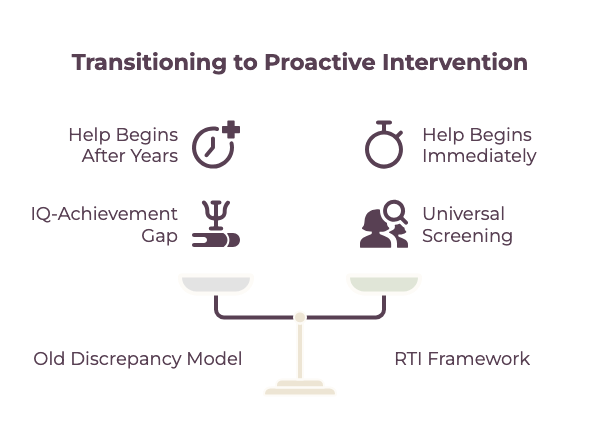
The framework emerged directly from the failures of how learning disabilities used to be identified. For decades, schools relied on the “discrepancy model,” where a student had to show a significant gap between their IQ and their actual academic performance before qualifying for extra help. In practice, this forced students to fail for years before getting support, an approach educators now bluntly call the “wait to fail” model.
The Individuals with Disabilities Education Act (IDEA) put an end to that by giving schools a clear path to use a student’s response to intervention as part of identifying learning disabilities. The law specifically allows districts to use “a process that determines if the child responds to scientific, research-based intervention” as part of a comprehensive evaluation, which is the exact language many states point to when justifying their RTI models. Today, all 50 states have adopted some version of a tiered support system.
RTI vs. the Old Discrepancy Model
| Approach | How Support Is Triggered | When Help Begins |
|---|---|---|
| Discrepancy model (older approach) | IQ-achievement gap must be documented | Often after years of struggle |
| RTI framework | Universal screening and progress data | As soon as a gap in skills appears |
How Does the RTI Framework Work?
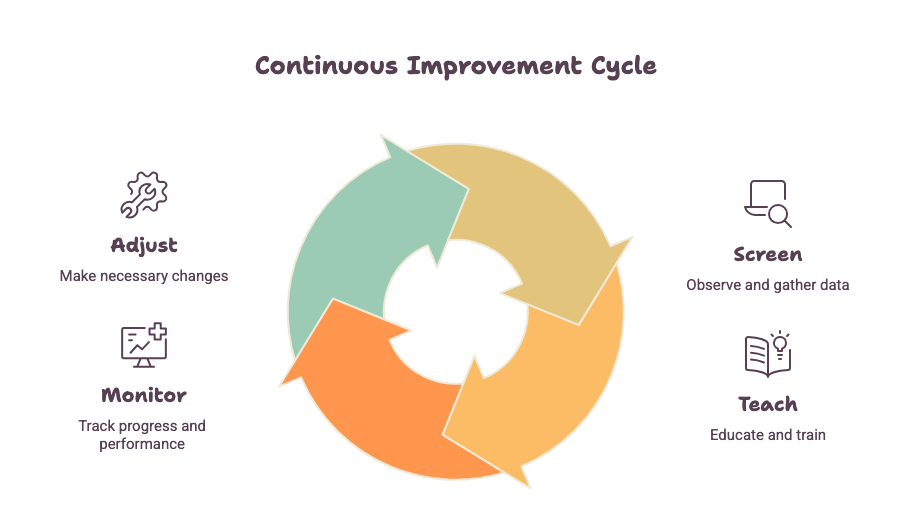
The RTI framework runs on four core practices working in sequence. Every student is screened early in the year using quick, standardized assessments. Teachers deliver strong, research-based instruction to the whole class as the first line of support. Students who don’t respond well to that instruction move into more targeted help, and their progress is tracked closely at every step.
What makes this a framework rather than a single program is that it doesn’t lock schools into one curriculum or one intervention. Instead, it establishes a clear decision-making structure: screen, teach, monitor, adjust, repeat. According to the Learning Disabilities Association of America, no single official RTI model exists, but every version shares the same core goal: use scientific, research-based interventions to bring students up to grade-level performance.
One misconception worth clearing up: RTI is not a “wait and see” approach. A teacher trying one classroom strategy and then waiting until the end of the grading period to check in isn’t running RTI, it’s just delayed reaction with an RTI label on it. The framework only works when screening, intervention, and data review happen on a tight, predictable cycle from the start.
What Are the Three Tiers of Support?
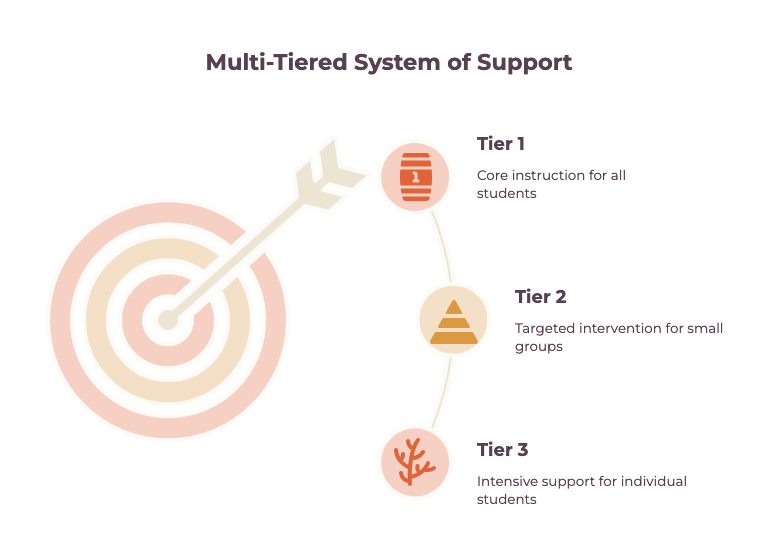
Tiered support is the piece of RTI most people picture, usually shown as a pyramid. Each tier delivers a different level of intensity, and students move between tiers based on how they respond to instruction, never based on a label or a diagnosis.
| Tier | What Happens | Typical Group Size |
|---|---|---|
| Tier 1 | High-quality core instruction for all students, plus universal screening | Whole class |
| Tier 2 | Targeted, small-group intervention in a specific skill area | 3 to 6 students |
| Tier 3 | Intensive, individualized instruction, often daily | 1 to 3 students |
Tier 1: The Foundation Every Student Receives
Tier 1 is strong classroom instruction delivered to every student, backed by universal screening a few times a year. Doug Fuchs, the Nicholas Hobbs Chair of Special Education and Human Development at Vanderbilt University, notes that most MTSS and RTI models expect roughly 80% of students to have their instructional needs fully met through Tier 1 alone. When that benchmark isn’t being hit, it’s usually a sign the core instruction itself needs strengthening, not a signal to look for more students to flag for extra help.
Tier 2: Targeted Small-Group Help
Students who don’t respond adequately to Tier 1 move into Tier 2, where they get additional instruction in a small group, typically 20 to 30 minutes several times a week, in a specific skill area like phonics or math fact fluency. Progress gets checked far more frequently here, because the entire point is catching problems before they grow.
Tier 3: Intensive, Individualized Instruction
Tier 3 is reserved for students who continue to struggle despite Tier 2 support. Instruction becomes fully individualized, sometimes one-on-one, and gets monitored weekly. In some districts, Tier 3 leads directly into a formal special education evaluation.
How Does Progress Monitoring Fit Into RTI?
Progress monitoring is what keeps the RTI framework grounded in evidence instead of guesswork. Teachers don’t assume an intervention is working, they collect regular data on student performance and use it to decide whether to continue, adjust, or intensify support. This is exactly what separates RTI from simply handing a student extra worksheets and hoping for the best.
An RTI overview from the IRIS Center at Vanderbilt University describes progress monitoring as the practice of tracking whether struggling students show adequate growth, or “responsiveness,” once high-quality instruction and intervention are in place, distinct from routine classroom quizzes. Without this data loop, schools have no reliable way to know when a student is ready to move back to a lower tier or needs to move up to a more intensive one.
In practice, this means a short, standardized check-in, often just a few minutes long, delivered on a fixed schedule. A Tier 2 reading student gets assessed on oral reading fluency every one to two weeks, while a Tier 3 student in an intensive math intervention gets checked weekly. The specific tool matters less than the consistency: without regular data points, a team has no real way to prove whether four weeks of intervention actually moved the needle.
How Is RTI Different From MTSS?
This question comes up constantly. Here’s the direct answer: MTSS (Multi-Tiered System of Supports) is broader than RTI. RTI focuses specifically on academic support and identifying learning disabilities, while MTSS applies the same tiered logic to academics, behavior, and social-emotional needs all at once.
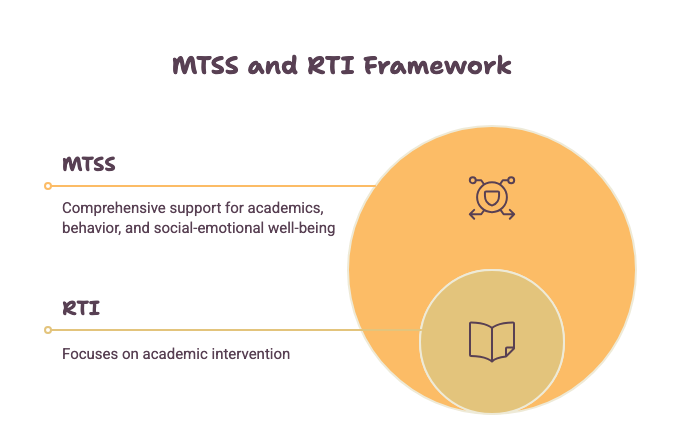
Most schools today use MTSS as the umbrella term and treat RTI as its academic component. Whichever term your district uses, the underlying tiered structure is nearly identical.
What Are the Benefits and Common Challenges of RTI?
RTI’s biggest strength is timing. Because support starts the moment universal screening flags a concern, students get help months or years earlier than they would under older identification models. It also breaks reliance on a single test score, since decisions rest on ongoing data collected over time rather than one snapshot.
The stakes here are significant at a national level. According to the National Center for Education Statistics, roughly 15% of public school students, about 7.5 million children, received services under IDEA in the 2022-23 school year, and specific learning disabilities remained the single largest disability category. A framework like RTI is part of what determines how early, and how accurately, those students get identified in the first place.
RTI still comes with real challenges, though. Scheduling consistent intervention time across a full school day is genuinely difficult, especially in schools where students rotate through many classes. Fidelity is another major issue: an intervention only works if it’s delivered exactly as designed, and inconsistent implementation is the single most common reason RTI underperforms in practice. Staffing and training are non-negotiable too, since Tier 2 and Tier 3 support demands teachers who know how to deliver targeted, research-based instruction, not just supervise extra practice time.
How Do Schools Get Started With RTI Implementation?
Schools start by selecting universal screening tools suited to their grade levels, training staff to interpret the data, and building a master schedule that protects consistent intervention time. From there, a team, typically general education teachers, a reading or math specialist, and an administrator, meets on a set schedule to review data and make placement decisions. Many districts now handle this with dedicated scheduling software rather than spreadsheets, since day-to-day usability tends to make or break whether the tiered model actually holds up under a real school calendar.
A few practical steps separate schools that get RTI right from schools that stall out:
- Pick screening tools before the school year starts. Waiting until October to decide how you’ll identify at-risk students costs weeks of critical early intervention time.
- Protect intervention time on the master schedule. If Tier 2 and Tier 3 blocks get bumped for assemblies or testing, the entire system loses consistency. Tools with built-in scheduling features, like conflict detection and real-time attendance, remove most of that risk.
- Train staff on the “why,” not just the “how.” Teachers who understand the reasoning behind tiered support implement interventions with far greater fidelity.
- Set a fixed data review cadence. Weekly or biweekly meetings keep placement decisions current instead of reactive.
The most damaging early mistake is treating RTI as a one-time referral process instead of an ongoing cycle. RTI only works when screening, teaching, and monitoring run continuously throughout the year, not just when a teacher raises a concern about a specific student.
Frequently Asked Questions
What does RTI stand for in education? RTI stands for Response to Intervention, a school framework that uses screening, tiered instruction, and ongoing progress monitoring to support students who are struggling academically.
How many tiers are in the RTI framework? Most RTI models use three tiers. Tier 1 delivers core classroom instruction for all students, Tier 2 provides targeted small-group support, and Tier 3 delivers intensive, individualized instruction.
Is RTI the same as special education? No. RTI is a general education framework that can help identify students who need a formal special education evaluation, but most students who receive RTI support never get referred for special education.
How long does a student stay in Tier 2 before moving to Tier 3? There’s no fixed national timeline, but most schools review progress-monitoring data every few weeks and allow 8 to 10 weeks of consistent Tier 2 intervention before deciding whether a student needs more intensive support.
What is the difference between RTI and MTSS? RTI focuses on academic intervention and learning disability identification, while MTSS is a broader framework that applies the same tiered approach to behavior and social-emotional support as well as academics.
Can parents request a special education evaluation while their child is still in RTI? Yes. Being in the RTI process doesn’t delay or replace a family’s right to request a formal special education evaluation at any time, regardless of which tier a student is currently in.
Final Thoughts: Why the RTI Framework Matters
Response to Intervention isn’t just another education acronym. It represents a fundamental shift toward catching students early, using real data instead of guesswork, and giving every student a level of support that matches exactly what they need. Understanding the RTI meaning and how tiered support works is the essential first step for any educator, administrator, or parent trying to make sense of how their school identifies and helps struggling learners.
If your school is building out or refining its RTI process, getting the scheduling and data-tracking pieces right from the start makes everything downstream far easier to manage. Visit RTI Scheduler Hub for the full resource center, including our RTI guides covering scheduling, attendance tracking, and progress monitoring in practice.