
An RTI scheduler is software that automates the process of organizing intervention, enrichment, and academic support sessions within a school day, matching students to the right group, room, and staff member automatically. If you’re still getting familiar with what RTI Scheduler is and how schools use it, that’s a good place to start. Keeping students focused during intervention time is one of the toughest parts of running a Response to Intervention (RTI) program. If sessions feel disorganized, students lose momentum fast, and staff end up spending more time managing logistics than actually teaching.

Some schools call this stretch of the day a flex block, an intervention period, a WIN block, or simply MTSS time, but the underlying challenge is the same: organizing dozens of moving pieces without losing sight of what each student actually needs.
In this guide, we’ll walk through eight practical ways a well-run RTI scheduler improves focus for both students and staff. Schools currently using RTI Scheduler span more than 450 K-12 campuses, and the patterns below reflect what consistently works across that range of settings, not just theory. Whether you’re just starting to explore scheduling software or looking to get more out of the system you already have, these strategies are built around what actually works in U.S. classrooms today.
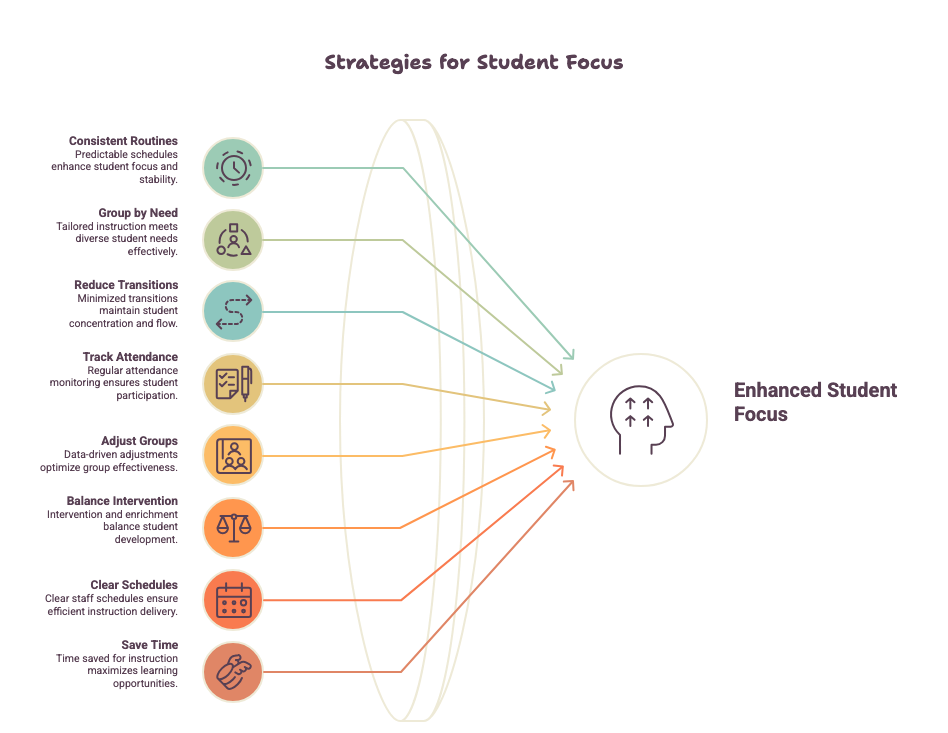
Here’s a quick look at what each strategy fixes before we dig into the details:
| # | Focus Strategy | Problem It Solves |
|---|---|---|
| 1 | Consistent, predictable routines | Students losing focus to constantly shifting schedules |
| 2 | Grouping by need, not convenience | Mismatched sessions that move too fast or too slow |
| 3 | Reduced transition time | Lost instructional minutes from delays and confusion |
| 4 | Real-time attendance tracking | Missed sessions going unnoticed until it’s too late |
| 5 | Data-driven group adjustments | Static groups that become too easy or too hard |
| 6 | Balanced intervention and enrichment | Flex time turning into an unstructured study hall |
| 7 | Clear staff schedules | Teacher stress and last-minute scrambling |
| 8 | Reduced scheduling workload | Administrative tasks crowding out actual instruction |
1. Why Does a Consistent Routine Improve Focus?
Students focus better when they know what to expect. A scheduler that assigns the same group to the same time slot and room each week removes the confusion of constantly shifting sessions. Predictability reduces the mental energy students spend just figuring out where to be, so more of their attention goes toward the actual lesson.
Consistency also helps staff. When interventionists aren’t rebuilding their weekly plan from scratch, they can spend more prep time refining instruction instead of chasing down room assignments. Over a full semester, that saved time adds up to dozens of extra planning hours that can go directly toward better lessons.
Think about how disruptive it would be for an adult to have their meeting schedule change every single day. Students feel that same disruption, often more intensely, when their support blocks move around without warning. A stable structure signals that the intervention time matters just as much as any other class on the schedule.
2. How Should You Group Students for Intervention?
One of the most common mistakes in manual scheduling is grouping students based on who happens to be free at the same time, rather than who actually needs the same type of support. A good RTI scheduler lets you sort students by current skill level and specific need, which keeps each session tightly focused instead of trying to cover too much ground.
Edutopia’s collection of RTI resources notes that effective intervention grouping depends on ongoing, structured assessment rather than convenience, since mismatched groups slow progress for everyone involved.
For example, mixing a student who struggles with basic decoding into a group focused on reading comprehension strategies means the lesson either moves too fast for one student or too slowly for the rest. Neither scenario keeps anyone truly engaged. A scheduler that lets staff filter and sort by specific skill gaps avoids this problem before it starts.
Why Skill-Based Grouping Improves Attention
When a session is targeted, students spend less time waiting for instruction that doesn’t apply to them. That alone cuts down on distraction and off-task behavior, especially with younger or easily distracted learners. Tightly matched groups also make it easier for interventionists to plan a single, focused lesson rather than trying to differentiate on the fly for a room full of students at different levels.
3. How Can You Reduce Transition Time Between Sessions?
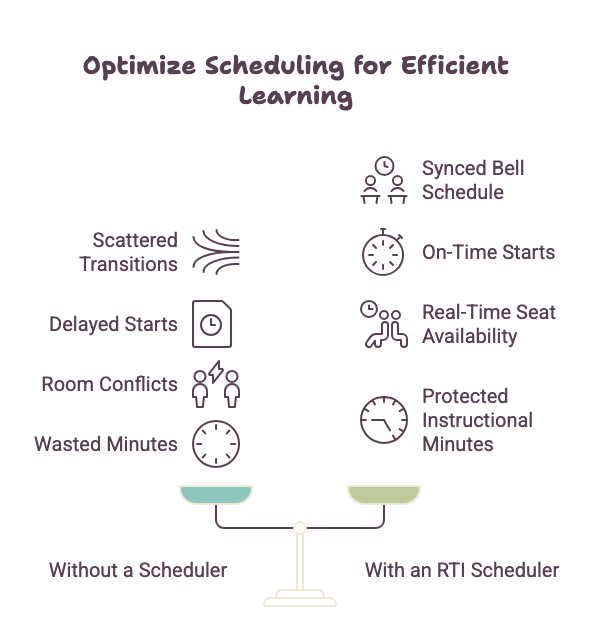
Every minute spent moving between classrooms, waiting for a room to open up, or figuring out where a group meets is a minute of lost focus. A scheduler that accounts for travel time and room availability across the building helps students move smoothly from class to intervention without unnecessary downtime.
This is especially useful in middle schools, where students already move between five to seven classes a day. Adding a poorly timed intervention block on top of that rotation can create chaos. A scheduler that respects the existing bell schedule keeps transitions short and sessions starting on time.
Even a five-minute delay at the start of a session can throw off the rest of the day for a small group. Multiply that across several sessions a week, and a school can lose a meaningful chunk of actual instructional time to nothing more than poor timing. Building transition buffers directly into the schedule, rather than hoping students arrive on time, removes that guesswork entirely.
Tools that sync directly with your student information system also help here, since real-time seat availability across rooms and staff prevents students from being routed to a session that’s already full. This kind of automation is one of several RTI Scheduler features built to remove manual guesswork from the process.
4. How Does an RTI Scheduler Track Attendance?
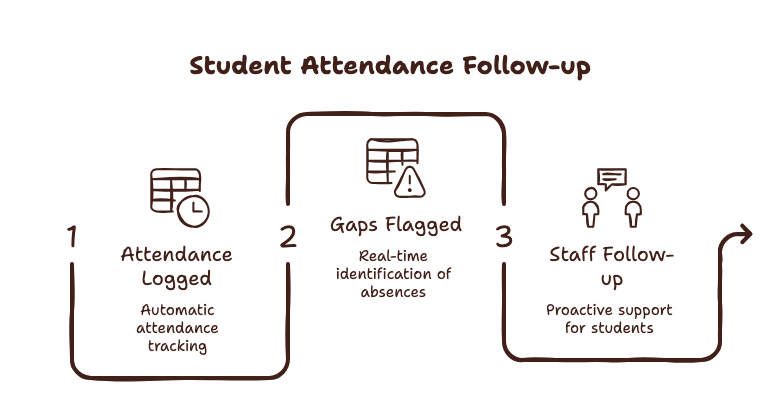
Missed sessions are one of the biggest hidden threats to student focus and progress. If a student skips two or three sessions in a row without anyone noticing, their group falls out of sync, and catching back up becomes harder. Built-in attendance tracking flags gaps immediately, so staff can follow up before a small issue becomes a bigger one.
Reliable attendance data also gives interventionists a clear picture of which students are consistently engaged and which ones may need a schedule adjustment or a different type of support altogether. In many schools, chronic absence from intervention sessions is a quiet problem that goes unnoticed until progress data reveals a student has fallen behind, by which point the gap is much harder to close. The U.S. Department of Education’s guidance on chronic absenteeism points to early, data-driven identification as one of the most effective ways to catch attendance problems before they compound. Automated tracking supports that kind of early identification by surfacing missed sessions as they happen, rather than waiting for a formal progress review weeks later.
This kind of engagement tracking also supports accountability at the building level. When administrators can see attendance and participation trends across every session, it becomes much easier to show that intervention time is actually being used the way it was intended.
5. How Often Should Intervention Groups Be Adjusted?
Static groups that never change tend to lose effectiveness over time. Some students progress faster than expected, while others need more intensive support. An RTI scheduler connected to current assessment data makes it easy to move students between groups as soon as new scores come in, rather than waiting for the next official review period.
This kind of responsiveness keeps academic support sessions appropriately challenging, which is one of the simplest ways to keep students engaged instead of bored or overwhelmed. A student who has mastered a skill but stays in the same group for another month is likely to disengage, while a student placed in a group that’s still too advanced may quietly stop participating altogether. Neither outcome supports focus or growth.
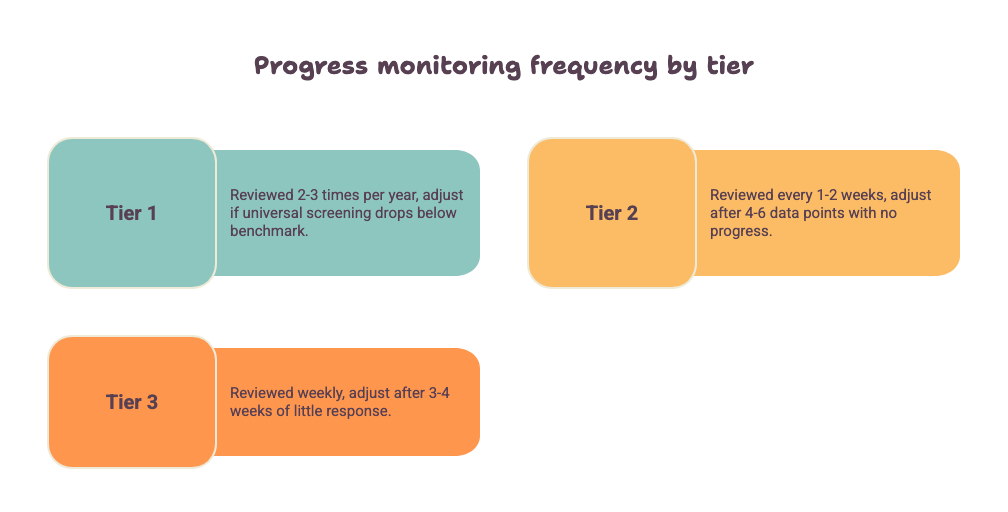
Regularly reviewing progress-monitoring data, ideally every one to two weeks for Tier 2 and Tier 3 students, gives staff the information they need to make these adjustments confidently rather than relying on gut instinct alone. The IRIS Center at Vanderbilt University notes that Tier 2 intervention should run for a minimum of 10 weeks with frequent, consistent progress monitoring throughout, so staff have enough data points to know whether a student is ready to move tiers rather than guessing after just a session or two.
| Tier | Recommended Review Frequency | Signal to Adjust the Group |
|---|---|---|
| Tier 1 | 2 to 3 times per year | Universal screening shows a drop below benchmark |
| Tier 2 | Every 1 to 2 weeks | No measurable progress after 4 to 6 data points |
| Tier 3 | Weekly | Little to no response after 3 to 4 weeks of intensive support |
6. Can an RTI Scheduler Handle Enrichment Too?
Focus isn’t only about remediation. Students who are ahead of grade level also need purposeful, engaging time built into their day. Many schools use the same scheduling infrastructure to organize extension activities, leadership opportunities, or community service and service learning projects during flexible blocks, sometimes called WIN time (What I Need) or an enrichment period.
Keeping the Whole Schedule Purposeful
When every student, not just those receiving intervention, has a clear and meaningful reason to be somewhere during that block, engagement improves across the board. It also prevents flex time from becoming an unstructured study hall that adds little value.
7. Why Do Teachers Need Clear, Simple Schedules?
A confusing master schedule creates stress for teachers and interventionists, and that stress tends to show up in the classroom. A scheduler that generates clean, easy-to-read rosters for each staff member reduces last-minute scrambling and lets teachers walk into each session already knowing exactly who’s coming and what the plan is.
Clear schedules also make it easier to bring in substitutes or additional support staff without confusion, since the system already has an accurate, current record of who belongs where. Instead of relying on a coordinator’s memory or a handwritten note taped to a door, anyone stepping in can pull up the same information the regular staff member would have used.
Some schools take this a step further by allowing self-enrollment for lower-stakes sessions, where students can choose from a list of approved options within a flex block. This still keeps staff in control of the overall structure while cutting down on the manual work of placing every single student by hand.
This matters more than it might seem. Teachers who feel prepared walk into a session calmer and more focused themselves, and that calm, organized energy tends to carry over to the students in the room.
8. How Much Time Can Schools Actually Save?
Perhaps the biggest focus booster of all: less time spent on scheduling logistics means more time spent teaching. Manual scheduling can eat up hours every week, time that could go toward lesson planning, one-on-one check-ins, or reviewing student progress. An RTI scheduler shifts that time back where it belongs. Schools running RTI Scheduler report saving an average of 15+ hours per teacher each month, time that previously went toward rebuilding spreadsheets and chasing down room assignments.
Scheduling complexity is a well-documented barrier to consistent RTI implementation, particularly in schools with rotating class periods where finding a common intervention window takes real coordination. Removing that barrier gives staff more room to focus on what actually moves the needle for students.
Frequently Asked Questions
What is an RTI scheduler used for? An RTI scheduler organizes intervention and enrichment groups within a school, matching students to the right sessions, avoiding time and room conflicts, and tracking attendance automatically.
How does an RTI scheduler improve student focus? It creates consistent routines, groups students by actual need, reduces transition time, and keeps sessions appropriately challenging by using current data, all of which reduce distraction and disengagement.
Can an RTI scheduler handle both intervention and enrichment? Yes. Many schools use the same system to schedule both support sessions for struggling students and enrichment activities for students who are ahead of grade level.
Is attendance tracking included in most RTI scheduling tools? Most modern RTI scheduling tools include built-in attendance tracking, which logs participation automatically and flags missed sessions so staff can follow up quickly.
Do middle schools benefit differently from an RTI scheduler than other grade levels? Middle schools often see the biggest impact, since students already rotate through multiple classes and teachers each day, making manual scheduling especially difficult to manage without software.
Final Thoughts: Better Scheduling Means Better Focus
Focus doesn’t happen by accident. It’s the result of predictable routines, well-matched groups, and a schedule that respects everyone’s time, students and staff alike. An RTI scheduler brings all of that together in one system, replacing scattered spreadsheets with a process that actually supports learning.
If your current intervention schedule feels harder to manage than it should be, it may be time to explore a dedicated RTI scheduler built for exactly this kind of work. Browse our RTI scheduling guides for more practical strategies to get started.