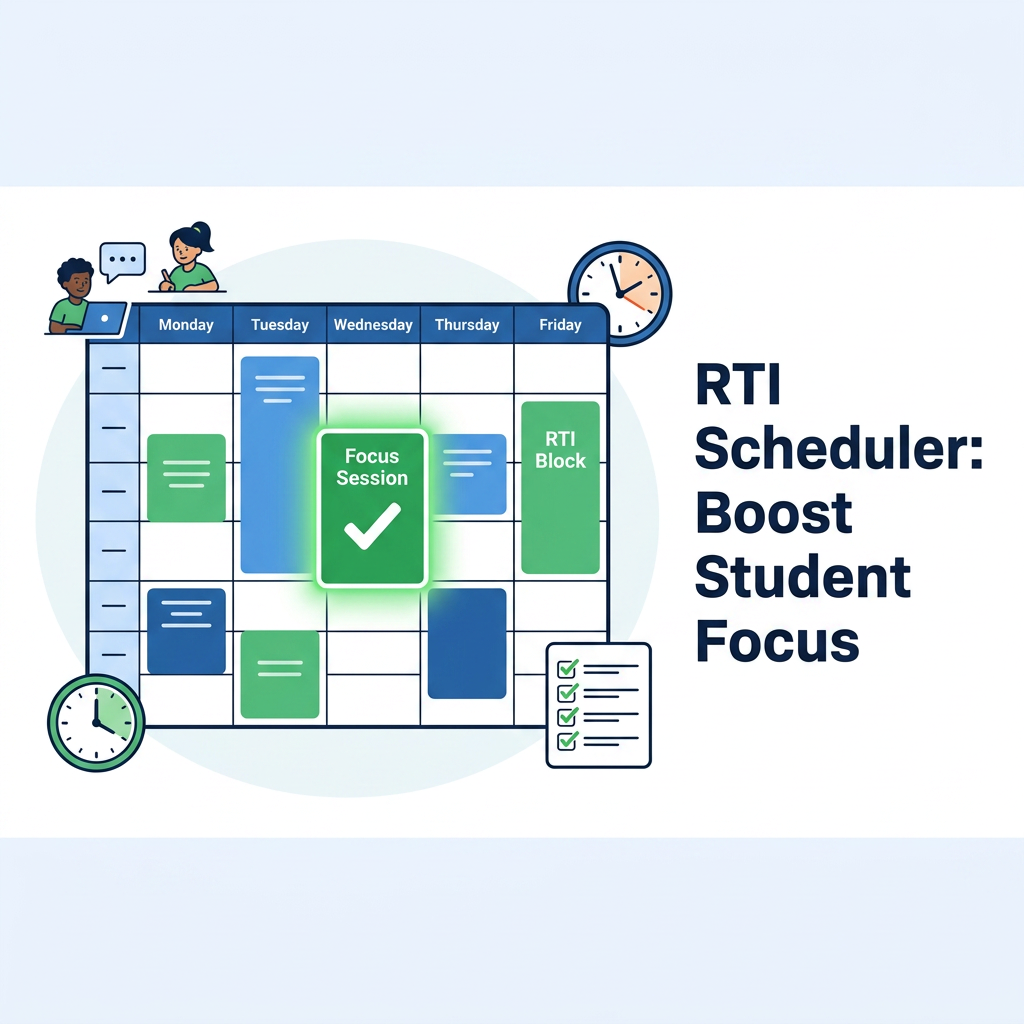
A small, focused intervention group and a clear weekly schedule on the wall, exactly the kind of structure an RTI scheduler helps create.

A student who doesn’t know where they’re supposed to be isn’t focused on learning. They’re
focused on figuring out the schedule. That sounds like a small thing until you watch it happen a dozen times a day across a middle school intervention block: kids wandering between rooms, teachers double-checking rosters, and ten minutes of every session lost before anyone actually starts working.
An RTI scheduler solves a problem that’s easy to underestimate: chaotic logistics quietly erode student focus and staff energy, long before anyone gets to the actual academic support. When the schedule is clear, predictable, and accurate, students spend their intervention time learning instead of wondering where to go, and teachers spend their time teaching instead of untangling rosters.
This guide covers how a well-run RTI scheduler creates the kind of structure that supports focus, what to look for in one, and how to put best practices to work in your own middle school.
In this guide:
- Why Scheduling Chaos Undermines Student Focus
- What an RTI Scheduler Actually Does
- Core Features That Support a Focused Intervention Block
- Best Practices for a Schedule That Keeps Students on Track
- Enriching Students Beyond the Intervention Block
- Common Scheduling Problems That Break Focus
- FAQ
Why Scheduling Chaos Undermines Student Focus
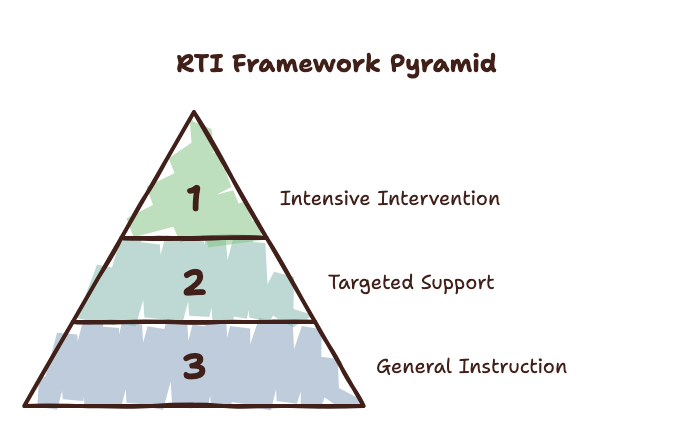
Response to Intervention (RTI) is a tiered framework used across U.S. schools to catch academic gaps early and respond with the right level of support: general instruction for all students, small-group help for those who need it, and intensive one-on-one intervention for those who need the most. According to the National Center on RTI at the American Institutes for Research, an effective framework rests on four pillars: universal screening, ongoing progress monitoring, tiered support, and data-based decision making.
None of those four pillars function well if the schedule underneath them is unreliable. A student who’s supposed to be in a Tier 2 reading group but ends up in the wrong room loses instructional minutes. A teacher who wasn’t told a group changed shows up with the wrong materials. This isn’t a minor issue: Edutopia reports that saving just 15 minutes a day through smoother transitions adds up to roughly 45 extra hours of instructional time per school year. Multiply that across dozens of groups and hundreds of students, and the cumulative loss of focus, for students and staff alike, becomes significant.
Quick Answer: An RTI scheduler is intervention-scheduling software that organizes student groups, manages attendance, and prevents the kind of logistical confusion that pulls focus away from actual academic support.
What an RTI Scheduler Actually Does
At a basic level, an RTI scheduler assigns students to the right intervention groups, keeps teacher and room assignments conflict-free, and logs who showed up. But its real value in middle schools is what it removes: the friction that turns a focused 30-minute intervention block into a scattered 20-minute one.
Keeps Groups Accurate as Data Changes
Progress monitoring in RTI programs typically happens every few weeks. A scheduler lets staff regroup students quickly when new data comes in, instead of leaving outdated groupings in place simply because updating them by hand is a hassle.
Reduces Transition Time
Clear, accurate schedules mean students know exactly where to go, cutting down the wandering-and-confusion minutes that eat into actual academic support time.
Centralizes Attendance Tracking
Reliable attendance tracking is not just a compliance checkbox. It’s the only way to know if a student is actually getting the extra help they’re assigned. A scheduler that logs attendance automatically catches gaps before they become a pattern.
Core Features That Support a Focused Intervention Block
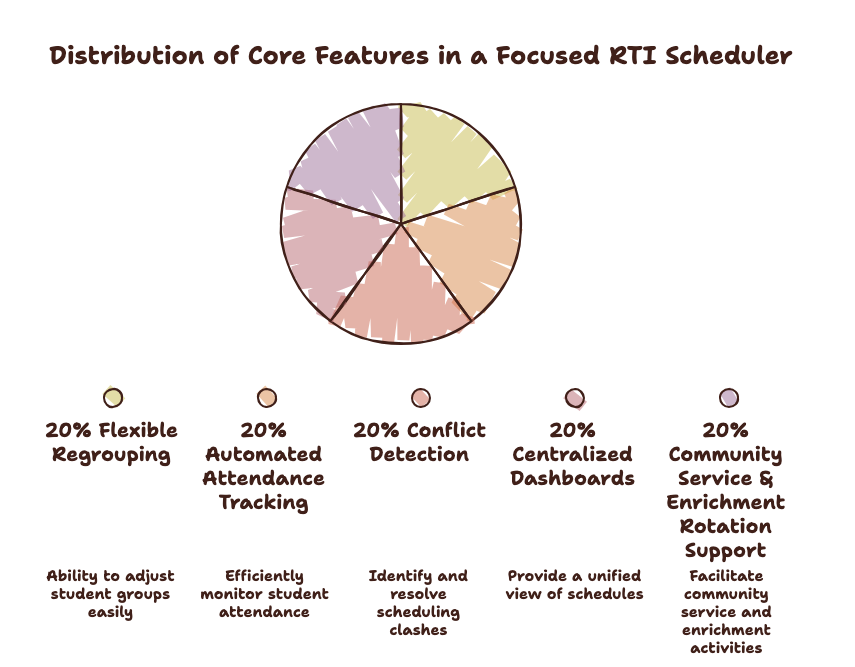
| Feature | Why It Matters for Focus |
| Flexible regrouping | Keeps students in the right group as data updates, instead of sitting in outdated placements |
| Automated attendance tracking | Removes manual logging errors that create confusion about who attended what |
| Conflict detection | Prevents double-booked teachers or rooms that derail a session before it starts |
| Centralized dashboards | Gives staff one accurate source of truth instead of scattered spreadsheets |
| Community service & enrichment rotation support | Keeps Tier 1 students purposefully engaged instead of idle during the block |
A scheduler that handles all five of these turns the intervention period into a block students can actually settle into and focus during, rather than one that starts with ten minutes of confusion.
Best Practices for a Schedule That Keeps Students on Track
Base Groupings on Current Data, Not Convenience
Group placement should follow the most recent assessment data, such as reading levels, math benchmarks, and behavior notes, not whatever fits neatly into an existing period. Stale groupings are a quiet source of lost focus, since students end up in sessions that no longer match their needs.
Keep Groups Small
According to the IRIS Center at Vanderbilt University, Tier 2 intervention is typically delivered in small groups of three to five students, with Tier 3 groups kept even smaller to allow for more individualized attention. Group sizes in that range make it easier for a teacher to hold everyone’s attention and catch disengagement early, something that gets harder to manage as group size grows.
Build In Predictable Routines
Consistency helps focus. When students know the block always starts the same way (check attendance, get materials, begin), they settle in faster than when the routine shifts week to week.
Use Non-Intervention Time With Purpose
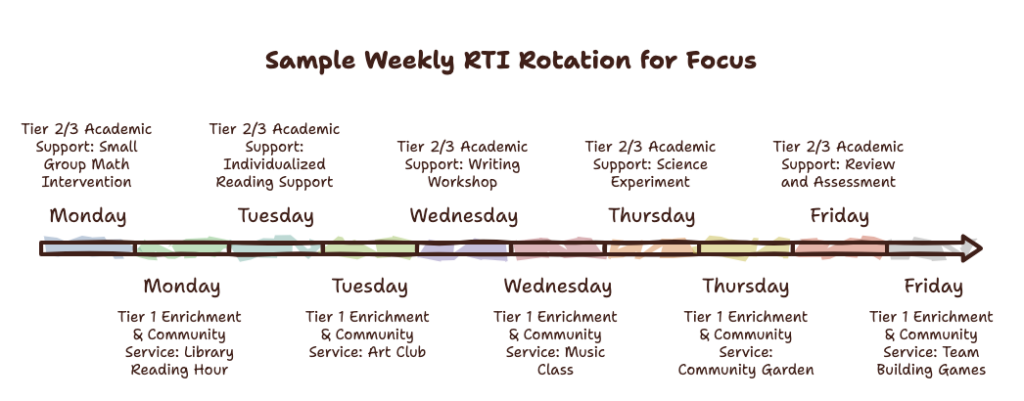
For students who don’t need remediation, service learning or community service rotations give the same block real structure instead of unstructured free time, which keeps the whole room more focused rather than half-engaged. Here’s what a purposeful weekly rotation might look like:
| Day | Tier 2/3 Focus | Tier 1 Focus |
| Monday | Small-group reading/math intervention | Enrichment club |
| Tuesday | Small-group reading/math intervention | Community service rotation |
| Wednesdy | Progress check-in | Enrichment club |
| Thursday | Small-group reading/math intervention | Community service rotation |
| Friday | Small-group reading/math intervention | Peer tutoring |
Real-World Example: According to RTI consultant Susan Fitzell, M.Ed., a high school in southwestern New Hampshire running a daily intervention block found its off-the-shelf scheduling tool didn’t fit the staff’s actual workflow. It was slow and left teachers manually rebuilding schedules on weekends. The school switched to a purpose-built RTI scheduling platform, Enriching Students, built specifically around how intervention blocks operate. It’s a pattern seen in many schools: generic scheduling tools create friction, while software designed for RTI reduces it. (Source: Susan Fitzell, “Meeting the Challenges of RTI Scheduling”)
Enriching Students Beyond the Intervention Block
Coordinating three tracks (targeted academic support, enrichment, and community service) inside one block is difficult to sustain with spreadsheets alone. A dedicated RTI scheduler makes recurring rotations manageable, tracks who’s completed which requirement, and adjusts automatically as students move between tiers.
Resources like the RTI Scheduler Hub guides walk through how to structure this kind of multi-track block in practice.
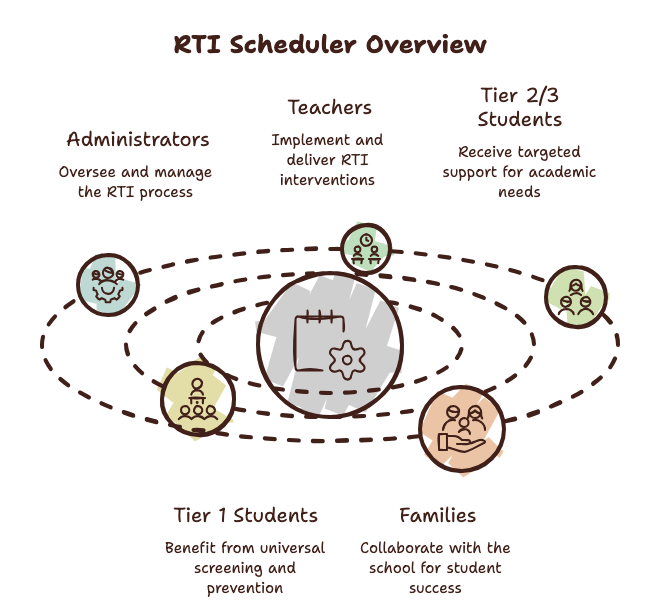
| Stakeholder | What Focus Looks Like for Them |
| Administrators | A block that runs itself, freeing time for oversight instead of firefighting |
| Teachers | Accurate rosters and materials ready before students walk in |
| Tier 2/3 Students | Consistent small-group support without wasted transition time |
| Tier 1 Students | A purposeful community service or enrichment rotation instead of idle time |
| Families | Clarity on what their child is doing during the block and why |
Common Scheduling Problems That Break Focus (and How to Fix Them)
Problem: Students don’t know where to go. Fix: Post schedules where students can see them and keep the source schedule centralized so it’s never out of date by the time students check it.
Problem: Staff resist a new scheduling system. Fix: Bring teachers into the selection or setup process early. Buy-in improves when the tool solves a problem staff have personally dealt with.
Problem: Attendance data is inconsistent. Fix: Standardize logging through the scheduler itself, and assign one person to review attendance weekly rather than leaving it to individual memory.
Problem: The block feels chaotic even with a tool in place. Fix: Map every component of the block, including intervention, enrichment, and community service, before building the schedule around it. Platforms like RTI Scheduler are built to handle exactly this kind of multi-track complexity. Planning tools at RTI Scheduler Hub can help with this step.
Frequently Asked Questions
How does an RTI scheduler help with student focus specifically?
By removing logistical confusion, such as wrong rooms, outdated groupings, and missed attendance, an RTI scheduler lets students spend intervention time on actual learning instead of figuring out where they’re supposed to be.
What does an RTI scheduler do?
It organizes students into the correct intervention groups, manages teacher and room assignments, and tracks attendance tracking data, replacing manual spreadsheets with one centralized, updatable system.
How often should RTI groups be updated?
Most middle schools review and adjust groups every four to six weeks based on progress-monitoring data, with faster-paced Tier 3 interventions sometimes reviewed every two to three weeks.
Can an RTI scheduler also manage community service rotations?
Yes. Many schools use the same scheduler to coordinate service learning and enrichment tracks for Tier 1 students alongside tiered academic groups.
What size should intervention groups be to keep students focused?
Smaller groups work best, typically three to five students for Tier 2 with even smaller groups for Tier 3, since it’s easier for a teacher to hold attention and catch disengagement in a small group.
Final Thoughts: Build a Schedule Students Can Actually Focus Within
The connection between scheduling and focus is easy to overlook, but it’s real: every minute lost to confusion, double-booking, or outdated groupings is a minute not spent on the academic support students actually need. A well-run RTI scheduler removes that friction, giving both students and staff a block they can settle into and use well.
If your school is ready to build an intervention period that supports focus instead of undermining it, explore the practical guides at RTI Scheduler Hub or see how a dedicated platform like RTI Scheduler can bring your schedule, attendance, and enrichment tracks into one clear system.
A calmer, more focused intervention block starts with a schedule your staff and students can actually rely on.